“A program does not fail because hiring managers or functional leaders break the rules. It fails when going around it is easier than going through it.”
Imagine you are a VP of engineering. Your team is fully booked on the roadmap, and a new priority lands: a mobile app that has to launch this quarter. Your engineers are strong on the web platform, but you need someone with iOS experience for the next three months, starting next week. Your program has one route for hiring, staff aug, and it is not built to find that person fast. So you do the rational thing. You find a contractor yourself, the work gets done, and nobody thinks twice about it.
But now the company has an engagement outside the program. No visibility, weak cost control, and nobody looking at the risk. Nobody set out to break a rule. The program just wasn’t the easiest way to get what the hiring manager needed.
Whether that happens in your company comes down to five things. Over the past few months, I have written about each of them on its own. But they don’t work in isolation. Fix one, ignore the rest, and your hiring managers and functional leaders still go around the program. So today I want to bring them together.
First, define the program by its purpose, not its pipes
Most companies treat whatever goes through the MSP and the VMS as the program, and everything else as outside it. So staff aug sits inside, independent contractors sit outside, and the hiring manager who needs that contractor falls into the gap.
But that line only shows where the pipes happen to run today.
The program is really there to give your hiring managers and functional leaders the talent they need, when they need it, with visibility and control. And more than one pipe can deliver that. Two companies can set it up differently, and both can be right. I wrote about this in Stop asking what is inside your contingent workforce program. Ask what gives you options.
Second, start from the job, not the worker type
Take the VP of engineering again. They do not need a worker type. They need someone with iOS experience ASAP. That is the job to be done.
Now comes the capacity question. The team does not have the hours, so the VP can cut scope or add capacity. And by reflex, adding capacity means calling the staffing agency they have used for ten years. Not because it is the best option, but because it is the only one they were left with. That is the capacity trap.
Third, know who carries the risk
Each way of engaging talent puts the risk in a different place.
With a directly engaged independent contractor, your company owns the classification decision and carries the exposure if it is later found to be wrong. Worker classification isn't a one-time check. It depends on how the work is actually done, and the rules vary by country, by state, sometimes by city, and they change over time.
If you engage through an agent of record, the AOR handles worker classification and provides indemnification protection, creating a layer of protection in between.
If you engage through an employer of record, the EOR becomes the worker's legal employer. Employment obligations such as payroll, tax withholding, and local employment compliance sit with them.
Some programs answer risk with a process so slow and heavy that hiring managers go around it. The risk did not go away. It just moved to where you cannot see it. That’s how the VP of engineering ends up outside the program again. So if a heavy process sends them around it, the real question is why people go around at all.
Fourth, make the program the easiest path
When a hiring manager goes around your program, the easy read is a discipline problem. I think that is wrong. Most programs were built for staff aug, so the hiring manager with an urgent need has no real front door. That is a capability gap, and you do not close it with a memo.
You close it by making the program the easiest path. The right people, fast. A cost that fits the budget. No compliance worry on their plate. And an experience as good as the apps they use in their private life. That is what I mean by making the program so good that not using it would be irrational.
If it still doesn't move, the blocker is usually inertia and friction. To break these, you need a champion, a functional leader or hiring manager who wants the outcome enough to push it through.
But even a program people want to use is only as good as the supplier behind it.
Last, look at what your supplier can actually do
A supplier that only provides staff aug is incentivized to push you into staff aug. And that is not bad faith. It is just an incentive. A supplier that can support independent contractors, agent of record, employer of record, and staff aug has no reason to push you into a single engagement model. I explain more in Why you want a supplier that does not care how you engage talent.
That is what we built Lifted, an Upwork Company, to be: a tech-enabled supplier that compliantly engages any type of contingent talent across 180+ countries, so you never choose the engagement model.
So look at your own program. If your hiring managers and functional leaders needed someone new next week, would they come through the program or find a contractor on their own? And which of these five is the reason?
P.S. Prefer to watch? I also post my videos on Lifted Studio. They run a few minutes each. And every past edition of this brief is on the newsletter page.
If this is the kind of thinking you want more of, subscribe. I write about what enterprise contingent programs are actually navigating, and what separates the ones that work from the ones that do not.
Author

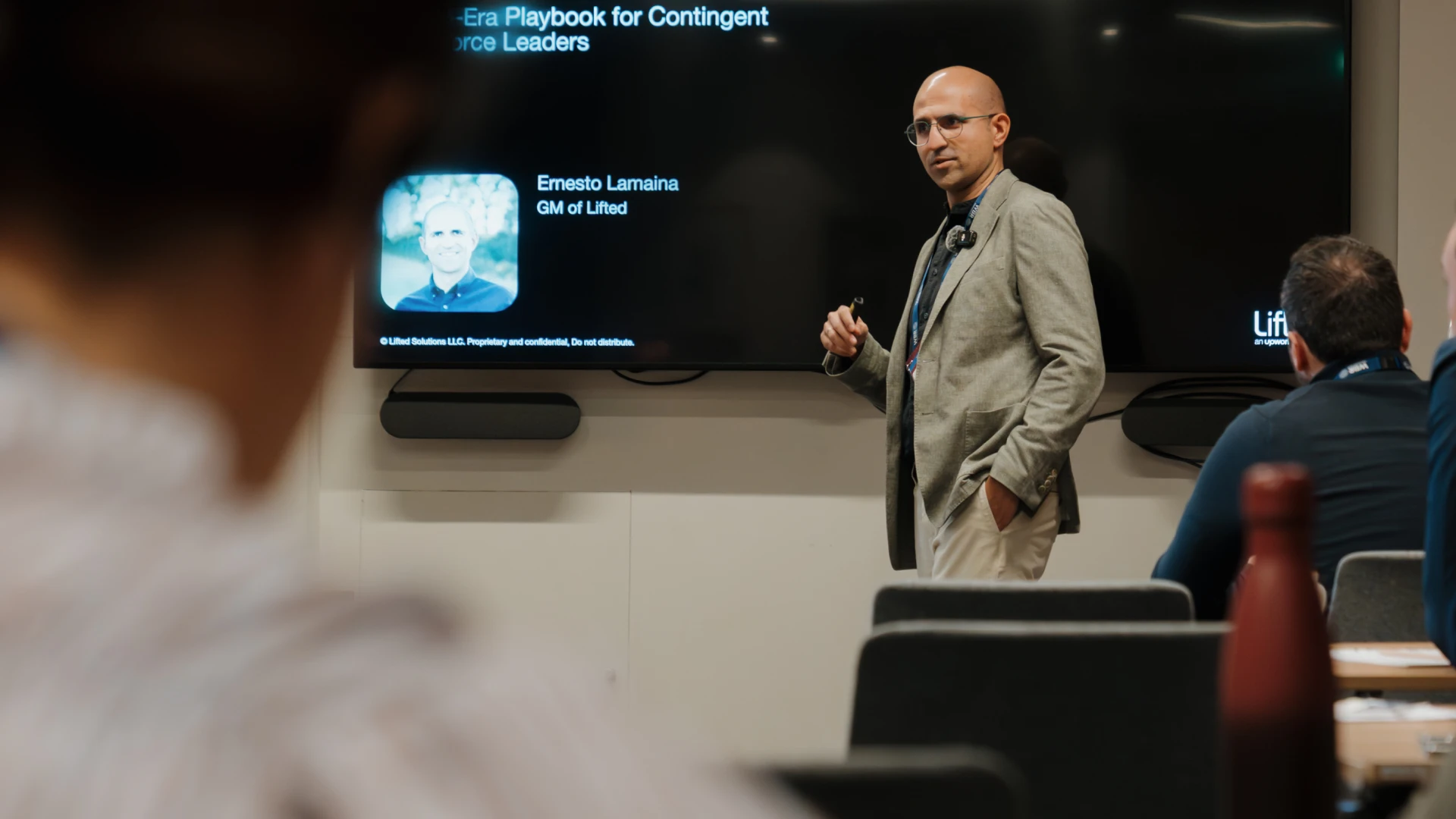
Ernesto Lamaina
GM, Lifted
Ernesto Lamaina is the General Manager of Lifted, an Upwork company dedicated to helping enterprises source, engage, and manage contingent talent across every contract type—independent contractors, staff augmentation, employer of record, and managed services.
This content is for general informational purposes only, and is not intended to be and should not be viewed as legal or tax advice. Readers should contact their attorney or tax professional to obtain advice with respect to any particular legal or tax matter. Information discussed can change frequently, and Lifted cannot guarantee that all information is current at all times.