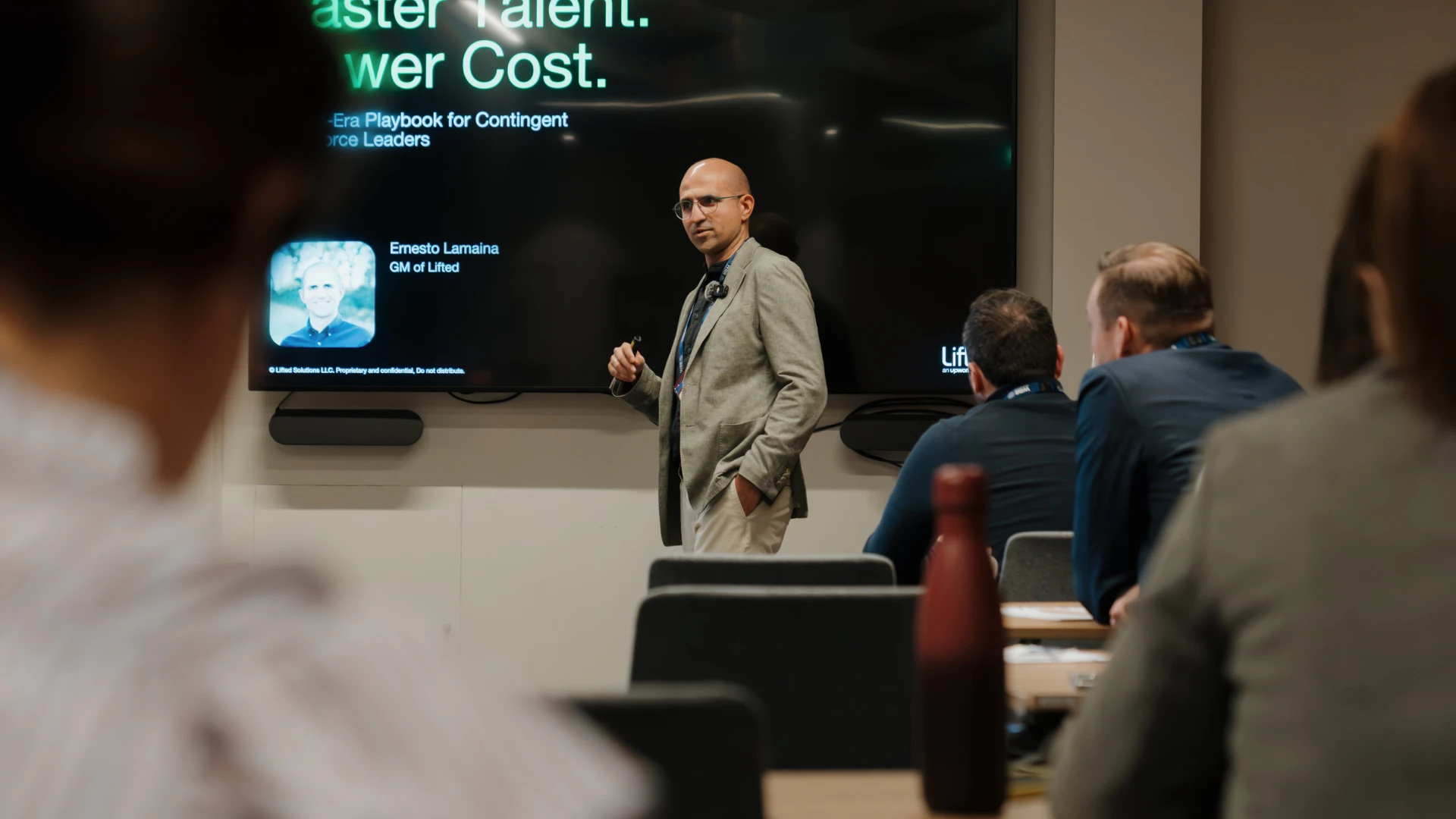
"No two companies are equal. No two contingent workforce programs are equal. So it is our job as suppliers to adapt to the customer, not the other way around."
There is a way of thinking that quietly limits what a contingent workforce program can be. We decide that whatever goes through the MSP and the VMS is inside the program, and whatever does not is outside. So independent contractors, agent of record, and employer of record get treated as things that live outside, while staff aug lives within. And then we manage them as if that line were a law of nature.
It is not. It is just where the plumbing runs today. The confusion comes from equating the program with the MSP and the VMS. But the program is not the plumbing. The program is the job of getting your hiring managers the talent they need, in the right way, with visibility and control. That can run through more than one pipe.
A better question
So if I am the program leader, I do not start with what goes through which system. I start somewhere else. What are the best tools I can use to maximize flexibility and access to talent for all of my hiring managers? Everything follows from that question.
And when you ask it that way, you see that several worlds can run in parallel, and not every company needs the same one. Take two shapes I see all the time. One company wants its staff augmentation going through the MSP and VMS, where it already has solid visibility and control, but does not want its independent contractors running through that same MSP and VMS, because that would slow them down and kill the flexibility. So it puts the independent contractors and agent of record on an FMS instead, and still gets the same visibility and control it has on the staff augmentation side. Another company wants the opposite. It wants everything, independent contractors, agent of record, employer of record, all of it, flowing through the MSP and VMS, because it has a specific mix it is trying to optimize and it wants one single view across all of it. Both are right. They are just optimizing for different things.
The job of a supplier
No two companies are equal, and no two contingent workforce programs are equal. So it is our job as suppliers to adapt to the customer, not the customer's job to adapt to us.
If a company wants its FMS sitting outside the MSP but still inside the program, that should be possible. If it wants to integrate with the VMS, that should be possible. If it wants to run outside the VMS entirely, that should be possible too. Maximizing the optionality available to the customer is, to me, an imperative for every provider in this space. That is the philosophy we built Lifted, an Upwork Company, around. Plug in like any other supplier, meet the program where it already is, and give it more options, not a mandate to change.
Why I am optimistic
I will end on why this excites me, because it genuinely does. The need for flexibility is going up, and AI is pushing it up fast. Things are moving faster than before. That only raises the value of being able to engage the right talent the right way, quickly. I believe contingent is how companies meet that need. Every company relies on talent today, and will rely on it even more tomorrow. And the programs that win the next decade will not be the ones with the most suppliers or the cleanest org chart. They will be the ones that gave their people the best talent, wherever they are in the world, with the least friction.
So drop the inside-versus-outside frame for a minute and look at your own program. If the only goal were to give your hiring managers the most options, what would you change first, and what has stopped you so far.
If you want more of this thinking, subscribe. I write about contingent workforce strategy, what is actually working in enterprise programs, and where I think the market is going.
Author

Ernesto Lamaina
GM, Lifted
Ernesto Lamaina is the General Manager of Lifted, an Upwork company dedicated to helping enterprises source, engage, and manage contingent talent across every contract type—independent contractors, staff augmentation, employer of record, and managed services.