"Fragmentation is not the enemy. Fragmentation with no plan to consolidate is."
Everyone in this industry agrees the contingent workforce is fragmented, and most people treat that as a problem to eliminate. I want to push back on that, because the goal is not zero fragmentation.
Some fragmentation is healthy
There is a reason fragmentation grows over time, in contingent and everywhere else. Things evolve. You get a new tool, a new vendor that does one piece of your process better, and you adopt it. That is natural, and I hope it never stops, because it is how the whole industry keeps improving.
So a certain level of fragmentation is not just acceptable; it is needed to keep innovation moving. The ambition should not be to collapse everything into one vendor. That is never going to happen, and you would not want it to.
Too much of it is a real problem
But there is a line. If you end up with 55 different vendors that all do roughly the same thing, because each can only do one little piece and none can do the whole, now you have a genuine problem.
How do you keep track of it?
How do you keep compliance in check, keep visibility, keep cost under control?
At that point, the question becomes: how do you consolidate some of it with tech-enabled vendors that can handle all contract types and support you globally?
Centralizing does not mean the MSP and the VMS
Here is where companies make a specific mistake. They assume that to consolidate, everything has to go through the MSP and the VMS. Sometimes that is exactly right, and they should do it.
But sometimes it is not.
Sometimes the right setup is to run some of it through the MSP, some through the VMS, and some outside, and that is not a loss of control. You lose control when you stop looking, not when you use more than one path.
The reason is that MSPs and VMS platforms were built for specific workflows, such as staff augmentation, and they are excellent at that. But push something like independent contractors through all of that overhead, and you lose the very cost and speed advantage that made independent contractors worth using.
So, the real job of the contingent workforce program manager is to define what centralizing means for their company. And only they can, because only they understand their own setup. Not a supplier, not a consultant.
What this looks like in practice
One large enterprise I work with made exactly this call. For staff augmentation, everything flows through their MSP and VMS. They have nailed that workflow, and their hiring managers like it.
But for agent of record, where Lifted, an Upwork Company, engages the independent contractors, handles the worker classification, and provides indemnification protection, they made a deliberate choice: the engagement does not start and end in the VMS.
The reporting still syncs back into the VMS, so they keep full visibility, but the hiring managers do not have to route through the MSP and VMS to engage, because every extra step costs speed and hurts the experience.
For staff aug, though, they run the same flow through the VMS, and we advise them to, because for that workflow it is genuinely the right home.
That is the whole point. Centralizing is not one shape. It is the shape that fits the company.
So look at your own program.
Where is fragmentation genuinely helping you innovate, and where has it just turned into a mess? And when you consolidate, are you defining what centralizing means for your company, or letting someone tell you it has to run through the MSP and the VMS?
If you want more of this, subscribe. I write about contingent workforce strategy, what is working in enterprise programs, and where I think the market is going.
Author

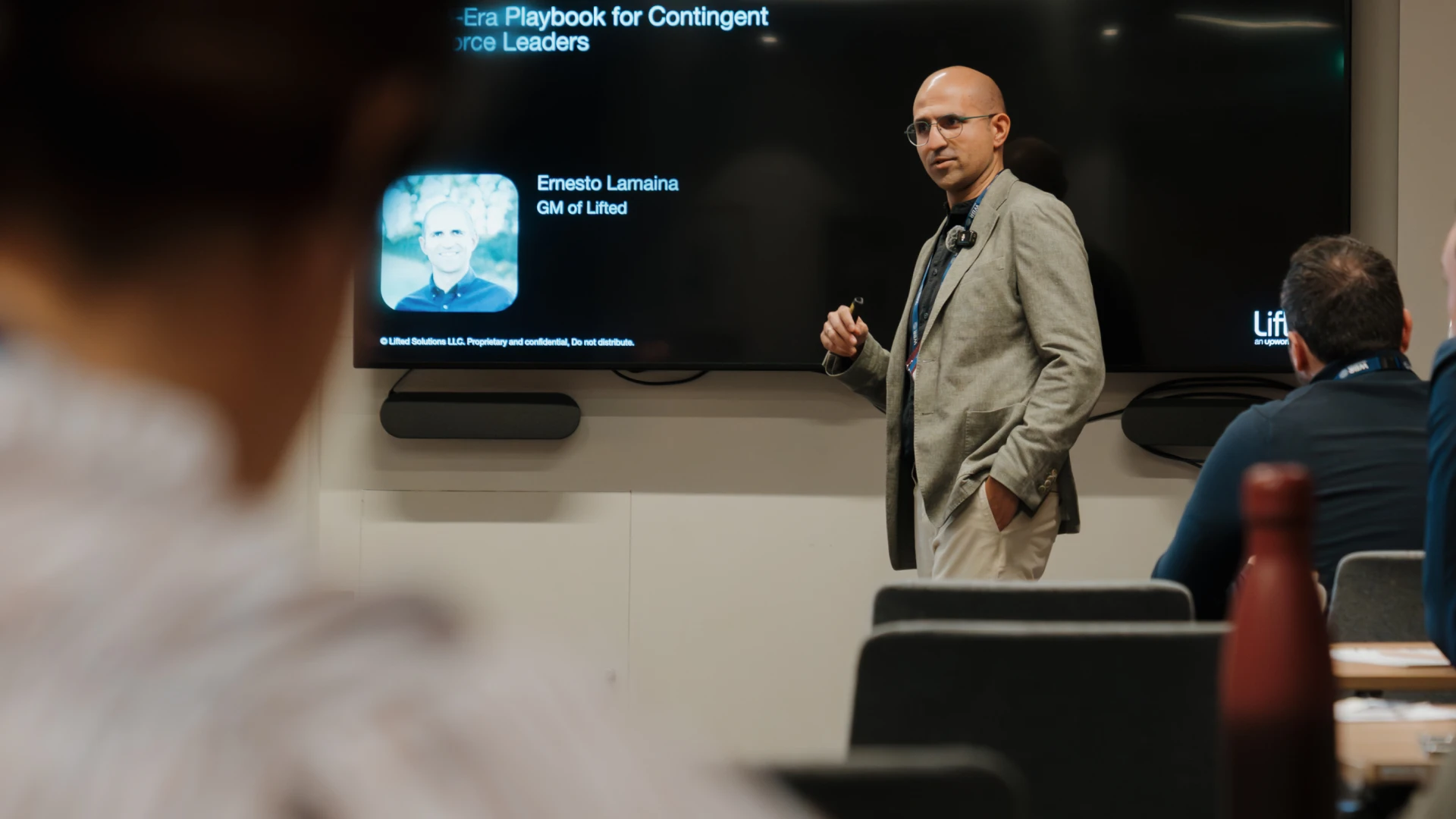
Ernesto Lamaina
GM, Lifted
Ernesto Lamaina is the General Manager of Lifted, an Upwork company dedicated to helping enterprises source, engage, and manage contingent talent across every contract type—independent contractors, staff augmentation, employer of record, and managed services.
This content is for general informational purposes only, and is not intended to be and should not be viewed as legal or tax advice. Readers should contact their attorney or tax professional to obtain advice with respect to any particular legal or tax matter. Information discussed can change frequently, and Lifted cannot guarantee that all information is current at all times.