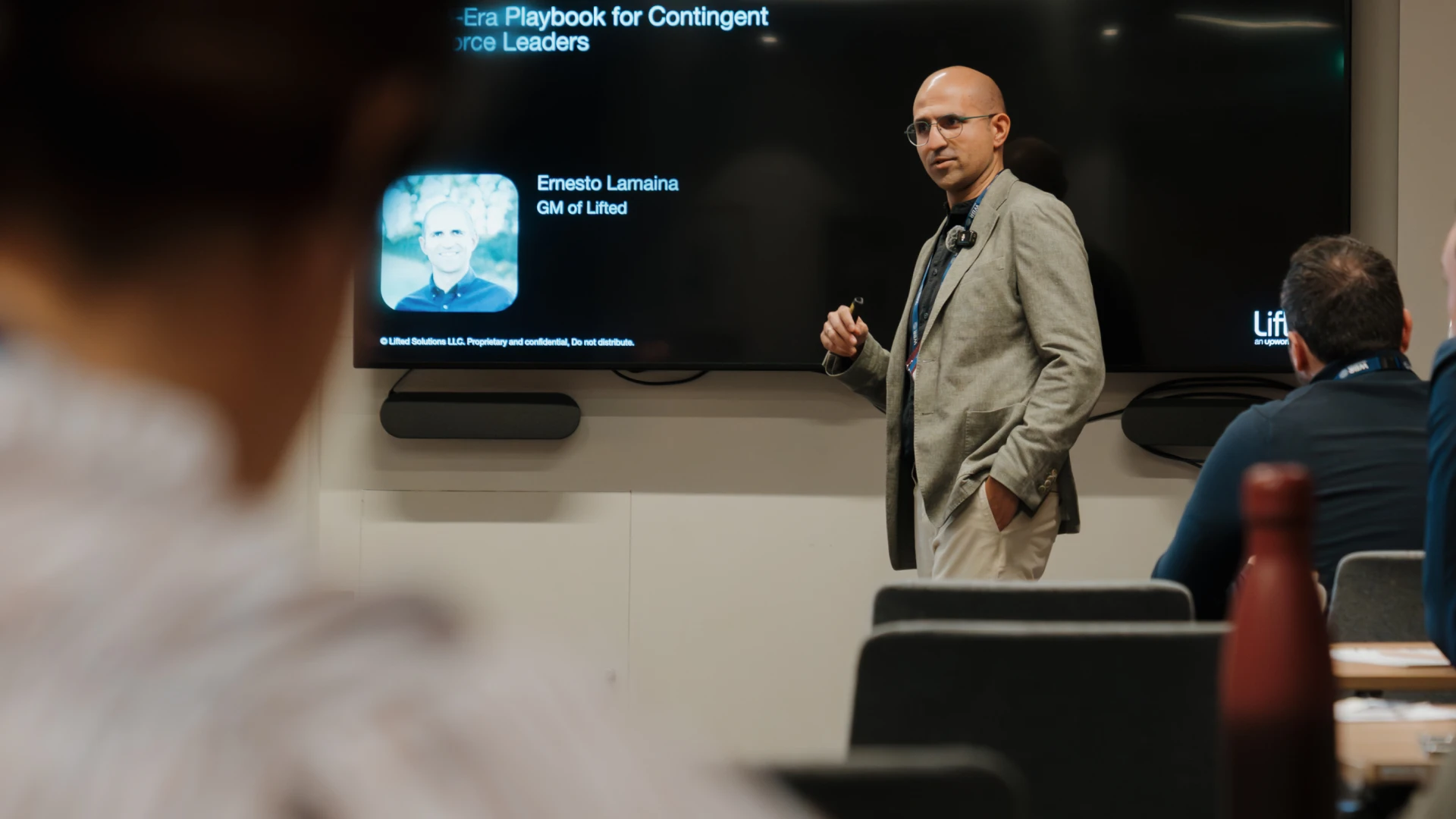
"Contingent does one thing for a company. It gives them flexibility. And in the era of AI, that need is not going up slowly. It is skyrocketing."
Let's think about what a company actually needs. To be a successful business, you need to preserve flexibility. Flexibility matters a lot. The more of it a business has, the more likely it is to succeed. And in the era of AI, where things change every day, the need for flexibility is not rising slowly. It is skyrocketing.
So let's think about what contingent does. Contingent enables flexibility. That is the whole reason it exists, and that is why companies end up using it.
Why it matters more now
Businesses have always needed to move fast. In the era of AI, they need to move even faster. A capability that was not on anyone's roadmap six months ago is suddenly the thing that decides this quarter. A competitor moves, a regulation moves, a new tool lands, and the plan everyone agreed to in January is the wrong plan.
To move that fast, a company needs a lot of operational flexibility. It also needs to operate at a cost base that makes sense for its business. And underneath all of it, compliance is a given, not a nice-to-have.
So the question for a contingent workforce program is whether it is actually delivering that flexibility, at a sensible cost, with compliance handled, or quietly working against it.
What flexibility actually means
When I say flexibility, I mean something specific. It comes down to two levers.
First, the countries you can engage people in. Second, the contract types you can use to engage them, whether that is staff augmentation, independent contractors, agent of record, or employer of record.
The more countries and the more engagement models you have available, the more room you have to move.
And once you have those two levers, you get a third one almost for free, which is expensive. With flexibility across countries and contract types, you can tune the cost up and down for different functions, different departments, and different needs.
You are not stuck paying one rate for one model in one place. You can match the engagement, and the cost to the actual job.
Where companies lose it
Here is what I see all the time. Companies constrain their own talent pool, and they do it to themselves.
They limit the countries they hire from because of internal policies or SOPs. They limit the contract types because of a technical limitation in some systems. They follow an SOP that is ten years old and still decides who they are allowed to engage.
None of that comes from the market. It comes from inside the company. And every one of those constraints shrinks the talent your hiring managers can actually reach.
A contingent workforce program should not artificially constrain the talent available to it. If the constraint is real, a legal reason, a genuine policy decision, fine. But most of the time it is not real. It is just something nobody has questioned in years.
I meet leaders all the time who are convinced the talent they need does not exist. Usually it exists. Their own program just will not let them get to it.
That is the part worth sitting with. In a world moving ten, a hundred, a thousand times faster than before, the companies that win are the ones that keep their options open. Flexibility is not a nice-to-have anymore. It is the operating model. And contingent is how a company actually gets it.
So here is the question. Where is your contingent workforce program least flexible right now, on countries, on contract types, on cost? And is that a decision you actually made, or just something you have been carrying because nobody asked why.
If this is the kind of thinking you want more of, subscribe. I write about contingent workforce strategy and what enterprise programs are actually dealing with.
Author

Ernesto Lamaina
GM, Lifted
Ernesto Lamaina is the General Manager of Lifted, an Upwork company dedicated to helping enterprises source, engage, and manage contingent talent across every contract type—independent contractors, staff augmentation, employer of record, and managed services.