“The way I think about EOR is like everything else: not in isolation.”
When a large enterprise evaluates a contingent Employer of Record (EOR), the conversation usually starts from what it has today. “Look, I have a large group of people I already found, and I need to engage them.”
That’s a reasonable place to start. It’s just not where the need ends.
How the evaluation usually goes
Let me walk through what I see. The company runs an RFP built around the talent it already has. So it finds the traditional contingent labor EORs, which engage pre-identified people but don’t provide talent sourcing. It picks one. And everything runs smoothly for a while.
Then things change. For example:
a) A person decides to take another job. People move on.
b) The function grows. The team that needed five people now needs eight, or needs a skill set it didn’t need last year.
c) Something else changes in the business, and the talent you have is not enough anymore.
And now what? You need to find new people. That usually means another vendor, or another tool.
Then you bring whoever you find back to the EOR to engage them. Two vendors, two processes, and the hiring manager in the middle.
The EOR is doing exactly what you bought it to do. You just bought it for the talent you had on the day of the RFP, not for the program you’re running a year later.
An Employer of Record that grows with you
So what would you want instead? One place where you can engage pre-identified talent as an EOR, and also source new talent.
Sit in the hiring manager’s seat. You already work with some people through the EOR. You need more. You click one button, and all of a sudden you have access to a talent pool of millions of active profiles. You find the person and engage them through the same EOR.
That helps in three ways:
A better experience.
More convenience for hiring managers and functional leaders.
More flexibility, because your talent pool is no longer fixed to whoever you started with.
There’s one more reason that gets overlooked: cost control.
When you can only engage the people you already have, it’s hard to see the alternative.
When you can also find new talent, you can always compare. You can ask: I already leverage this talent, is this really the best option for me? Or should I look at a different skill set, different countries, different profiles?
Watch the incentive, too
The second reason I never look at an EOR on its own is the Agent of Record (AOR).
Assume your EOR doesn’t have extensive AOR capability. That vendor has every reason to push you toward the EOR model, even when it’s not needed. Why? Because it can’t do AOR, or because AOR is not economically convenient for it.
I’m not saying anyone does this in bad faith. It’s just how incentives work. A vendor recommends what it can deliver.
The hiring manager might not notice. But your program feels it. Either you don’t get the best possible experience, or you don’t get the best possible price.
What I’d look for
If I were running that RFP again, I’d look for two things.
First, EOR and AOR from one supplier, so each person is engaged based on the worker classification result, not on what your vendor offers.
Second, talent sourcing. Not only engaging the pre-identified talent you bring, but also finding more talent to engage through an EOR when you need it.
That’s how we built the contingent EOR solution at Lifted, an Upwork Company.
So the point is this: choose your EOR for the program you’ll run next year, not only for the list of names you have today.
If one of your key EOR workers left tomorrow, or a team suddenly needed twice as many people, what would the hiring manager do next? And how many vendors would they need to go to?
If you want more of this, subscribe. I write about contingent workforce strategy, what is working in enterprise programs, and where I think the market is going.
Author

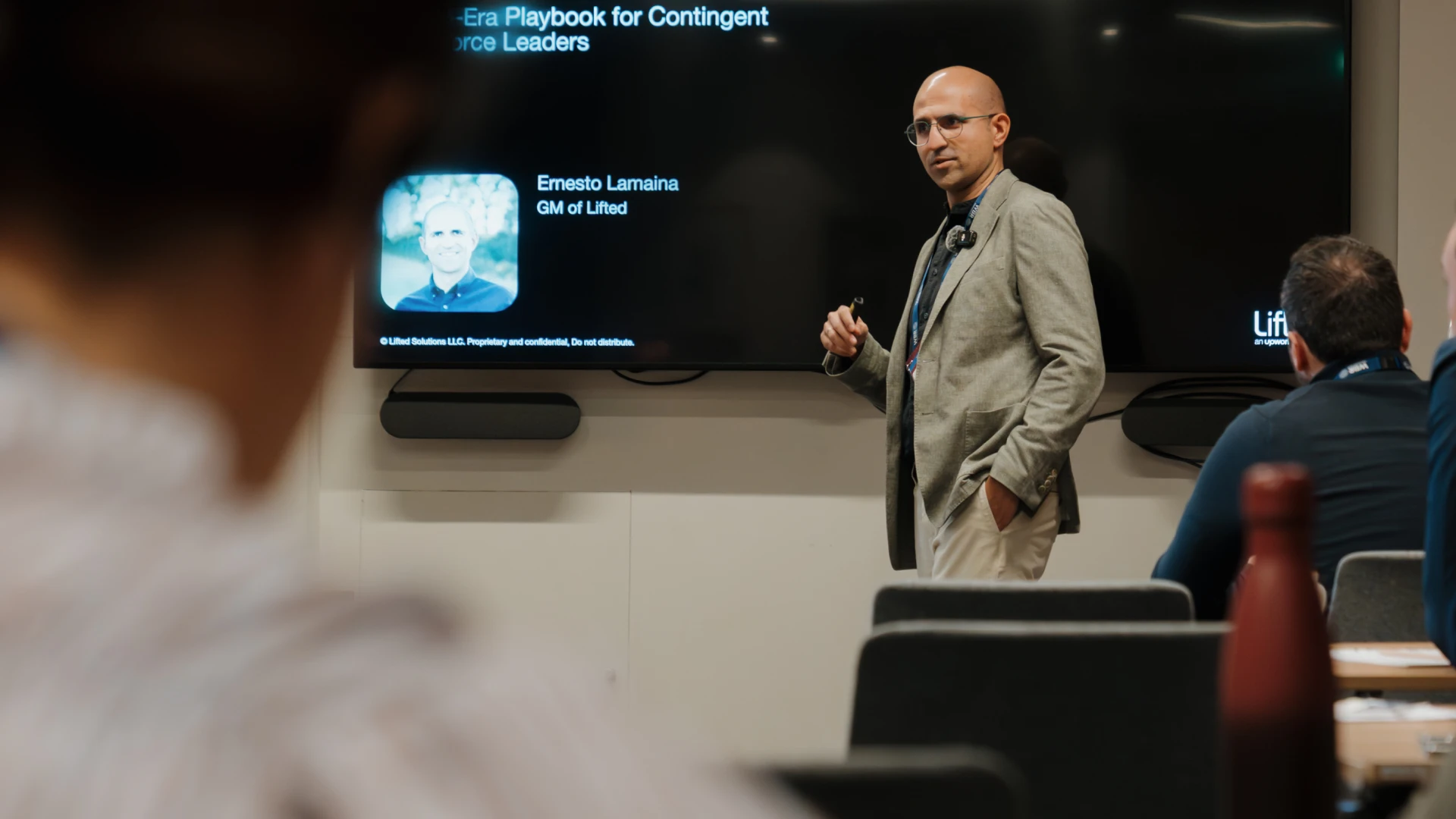
Ernesto Lamaina
GM, Lifted
Ernesto Lamaina is the General Manager of Lifted, an Upwork company dedicated to helping enterprises source, engage, and manage contingent talent across every contract type—independent contractors, staff augmentation, employer of record, and managed services.
This content is for general informational purposes only, and is not intended to be and should not be viewed as legal or tax advice. Readers should contact their attorney or tax professional to obtain advice with respect to any particular legal or tax matter. Information discussed can change frequently, and Lifted cannot guarantee that all information is current at all times.