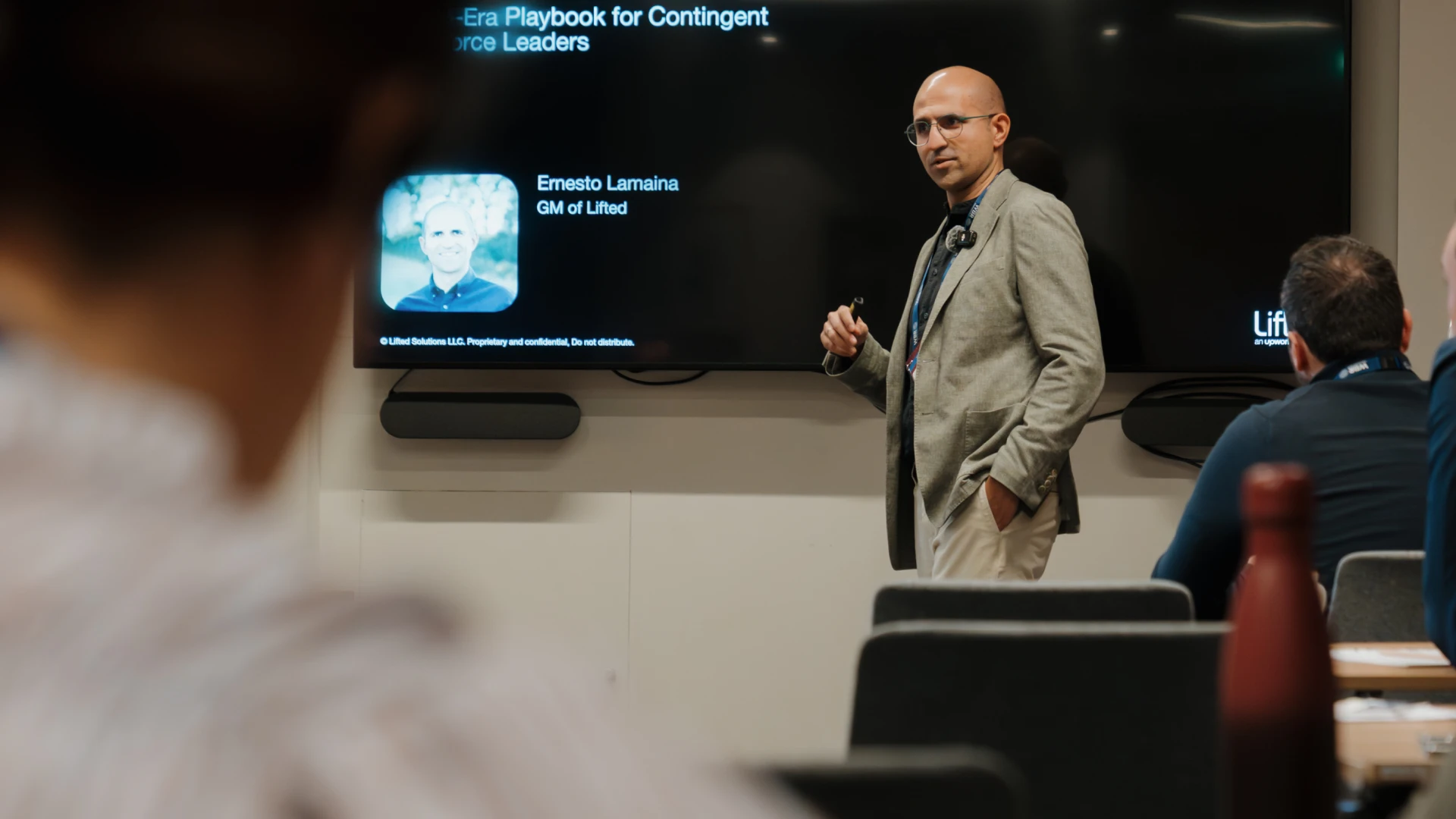
"Many people put every employer of record in one group and call it EOR. But there are different types."
Many contingent program leaders compare employers of record that were built for very different jobs. I’ll start with what an employer of record is. Then the difference that matters.
What an employer of record is
An employer of record (EOR) is a provider that compliantly employs someone on behalf of another company. Pretty straightforward.
In the contingent space, it’s one more tool in the toolkit. It gives functional leaders and hiring managers more flexibility.
Why a large enterprise uses EOR
A large enterprise can usually employ people directly. So why use an EOR?
There are a few reasons:
No entity in that country.
You’d rather have someone else employ a certain group of workers (due to risks or locations)
The experience for the hiring manager and the worker.
Two types of EOR
The first type is long-term EOR. It employs someone you already found, for a long time.
Assume you hire a senior engineer in the Netherlands. You have no entity there. The EOR employs them for two years. Same person, same country, same hours.
The second type is contingent EOR. It can do that too. But it’s built for work that changes.
Imagine you need a specialist for a product launch, in a country where you have no entity. Part-time at first. More hours as the launch gets closer. Maybe an extension after. Hours shift and the end date moves.
Most large enterprises have a lot of the second kind.
Contingent EOR isn’t new. Technology is what changes it.
Contingent EOR has existed for a long time. The need isn’t new.
But most legacy providers have little technology. And technology makes a difference.
Think about why you use a contingent EOR in the first place. You want more flexibility. You want lower cost. You want more convenience. Technology delivers all three.
Flexibility: Hours shift. A project gets extended or ends early. With the right technology, you make the change in the system, and it takes effect fast. No chain of emails, no miscommunications.
Convenience: The technology handles & abstracts each country’s employment rules. The hiring manager starts a worker in a few clicks and gets back to their job. They don’t need to be an employment law expert.
Cost: The technology does the admin: start dates, hour changes, extensions. Without it, people do that work by hand, and the time goes into your price.
The more & better technology an EOR provider has, the more flexibility, convenience, and savings you get. That’s the whole case.
What I’d look for
If you’re choosing a contingent EOR, start with one question. Was it built for contingent work, or adapted from long-term EOR?
Then ask:
How does it handle shifting hours, short projects, and extensions?
Can my hiring manager start, change, or extend a worker in an easy way?
How long does a change take, from request to done?
If you’re choosing a contingent EOR, start with one question. Was it built for contingent work, or adapted from long-term EOR?
At Lifted, an Upwork Company, we focused on exactly that: technology built specifically for the contingent labor space, so that employing a worker through our EOR is faster and easier for hiring managers and for centralized contingent workforce programs.
Now look at your own EOR work.
How much of it is long and stable? How much is shorter, with shifting hours? And is your EOR built for the second group, or just putting up with it?
If you want more of this, subscribe. I write about contingent workforce strategy, what is working in enterprise programs, and where I think the market is going.
Author

Ernesto Lamaina
GM, Lifted
Ernesto Lamaina is the General Manager of Lifted, an Upwork company dedicated to helping enterprises source, engage, and manage contingent talent across every contract type—independent contractors, staff augmentation, employer of record, and managed services.
This content is for general informational purposes only, and is not intended to be and should not be viewed as legal or tax advice. Readers should contact their attorney or tax professional to obtain advice with respect to any particular legal or tax matter. Information discussed can change frequently, and Lifted cannot guarantee that all information is current at all times.