Key takeaways
AI is accelerating demand for specialized talent, not reducing it.
Contingent workforce is becoming essential to AI execution.
Fragmentation is the biggest barrier to scaling AI.
Speed, flexibility, and contract optimization define competitive advantage.
Picture this: a small business owner in the UK, working on a Saturday night, spends two hours chatting with a company's AI-powered chatbot. By the end of it, they've convinced the bot to sell a £10,000 product for £2,000. An 80% discount. Automatically authorised. Gone.
It's a vivid reminder that deploying AI without the right human infrastructure doesn't just create inefficiency, it creates risk. And it's one of many stories circulating among enterprise leaders right now, alongside genuine successes that show what's possible when implementation is done right.The tension between AI's extraordinary capability and the reality of how slowly most enterprises are actually deploying it is exactly where contingent workforce leaders need to act.
What the data actually says about AI adoption right now
Four out of five large enterprise companies now use some form of generative AI. Two years ago, that number was under 30%. The adoption curve has been near-vertical.
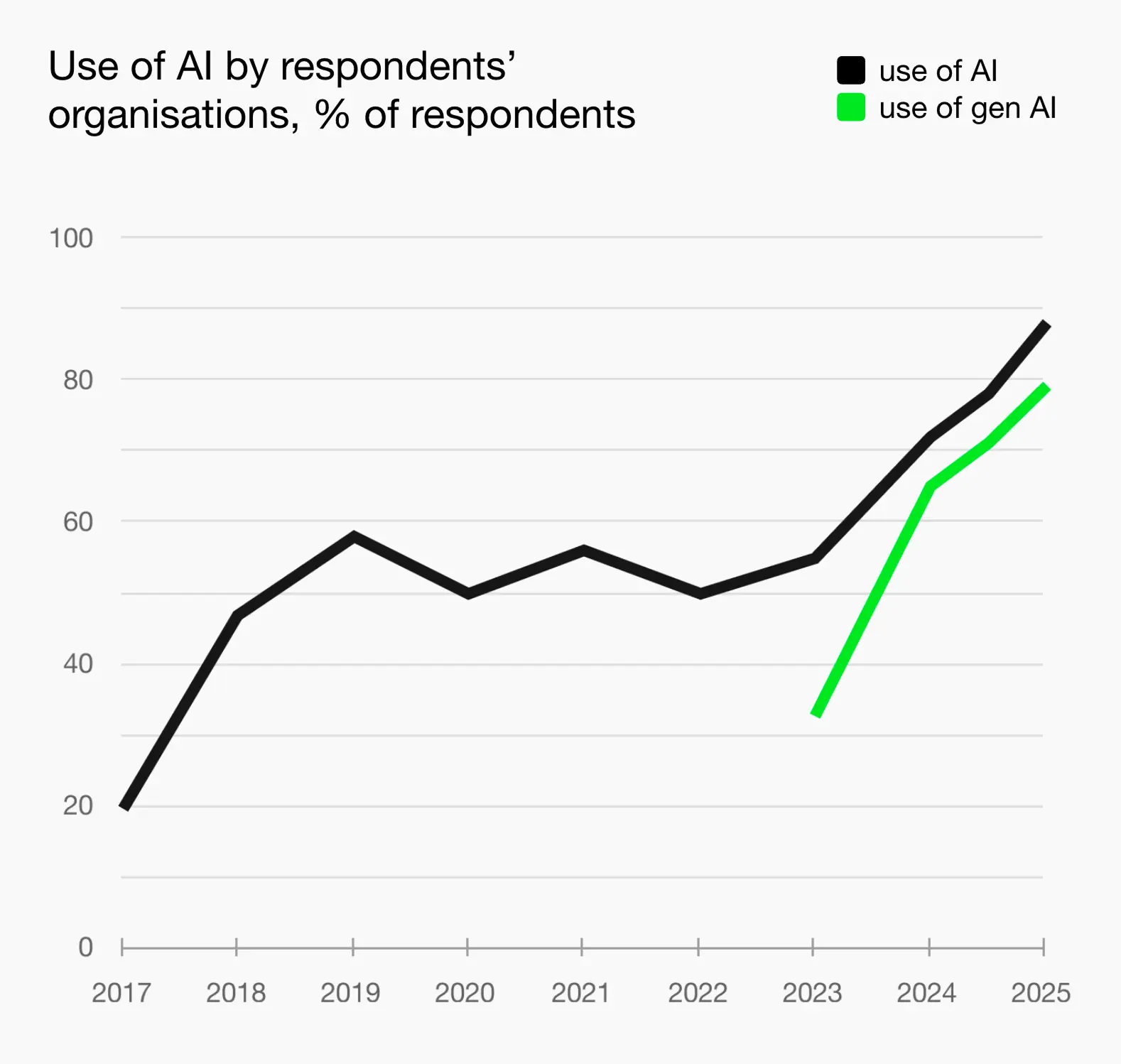
But here's the contradiction: when you look at how deeply AI is being deployed across business functions, most companies are barely past the surface. AI capability has outpaced AI implementation, and the gap between the two is where the real opportunity sits.
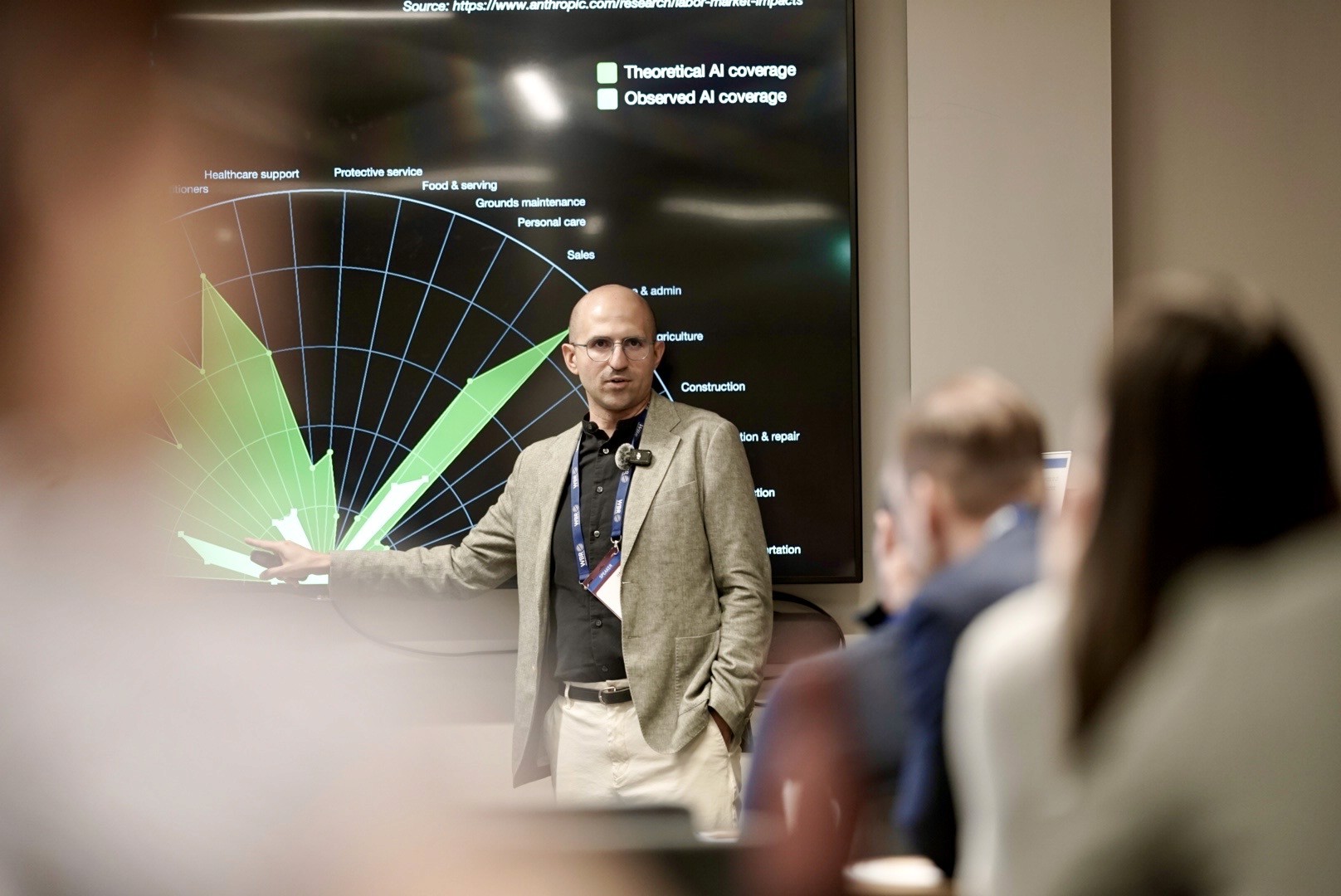
Anthropic's own data shows this clearly: AI has reached extraordinary levels of capability in areas like computation, data analysis, and content generation. Real-world enterprise adoption of those advanced capabilities? Still very low.
This isn't a technology problem. It's a talent and infrastructure problem. And it's one that contingent workforce leaders are uniquely positioned to solve.
Is AI replacing people or creating new demand for them?
Most headlines tell you AI is eliminating jobs. However, as AI capability expands, so does the need for skilled humans to implement it, oversee it, and complete work it cannot finish alone. Engineers who train models. Specialists who validate outputs. Human-in-the-loop workers who bridge what AI can do and what clients actually need.
‘Our fundamental belief, and what we see, is that AI adoption actually equals contingent workforce growth.’

Ernesto Lamaina
GM at Lifted
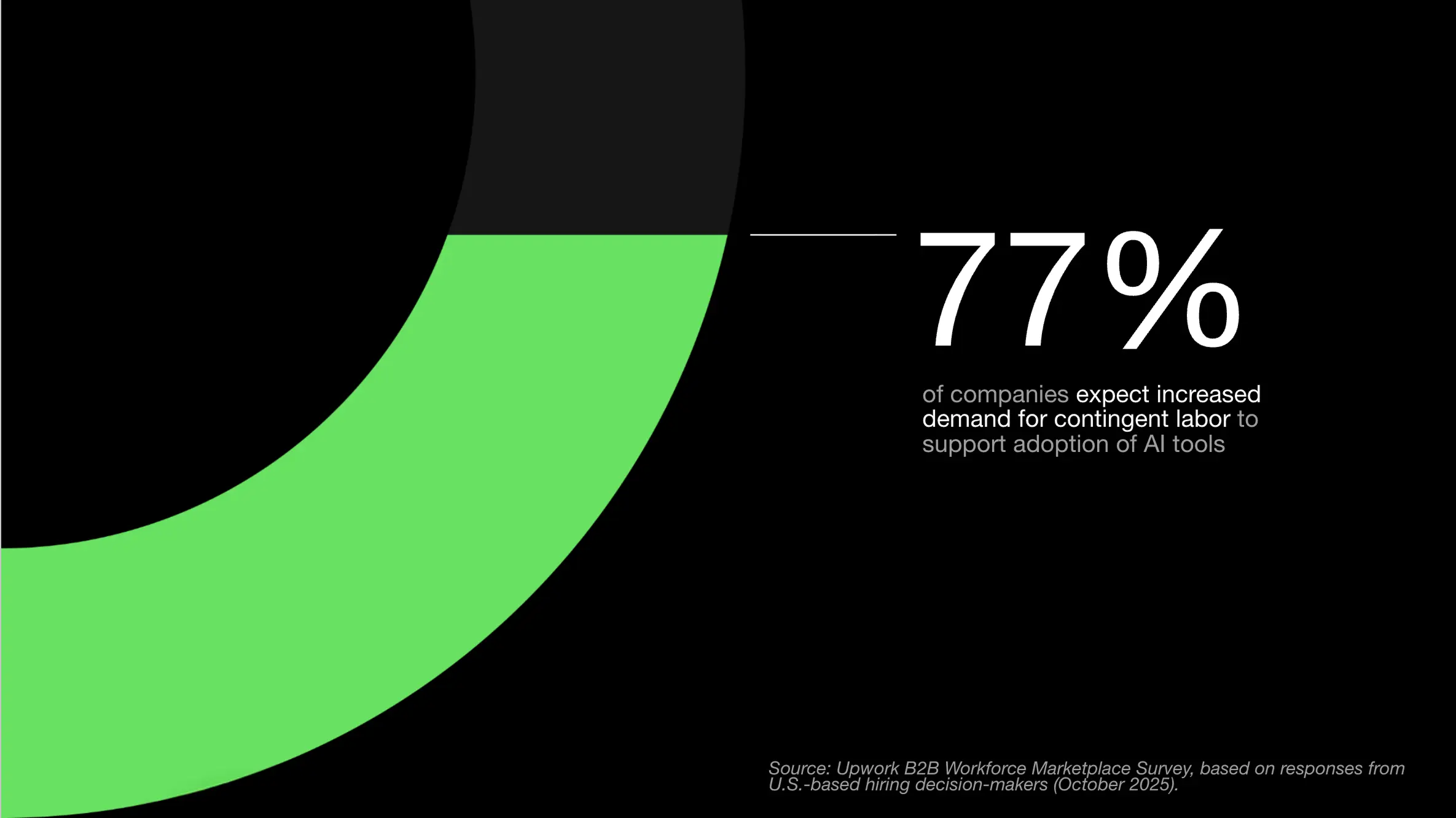
Lifted's survey data, gathered with consulting partners and enterprise clients, found that 77% of leaders say the need for fractional and contingent roles is growing in their companies because of AI, not despite it.
Why does AI specifically favour the contingent model?
There is a contradiction at the heart of most large enterprises right now. On one side: 92% of C-suite leaders say their companies have up to 20% too many workers. On the other: one in three leaders report talent gaps of 40–60% in AI-critical roles.
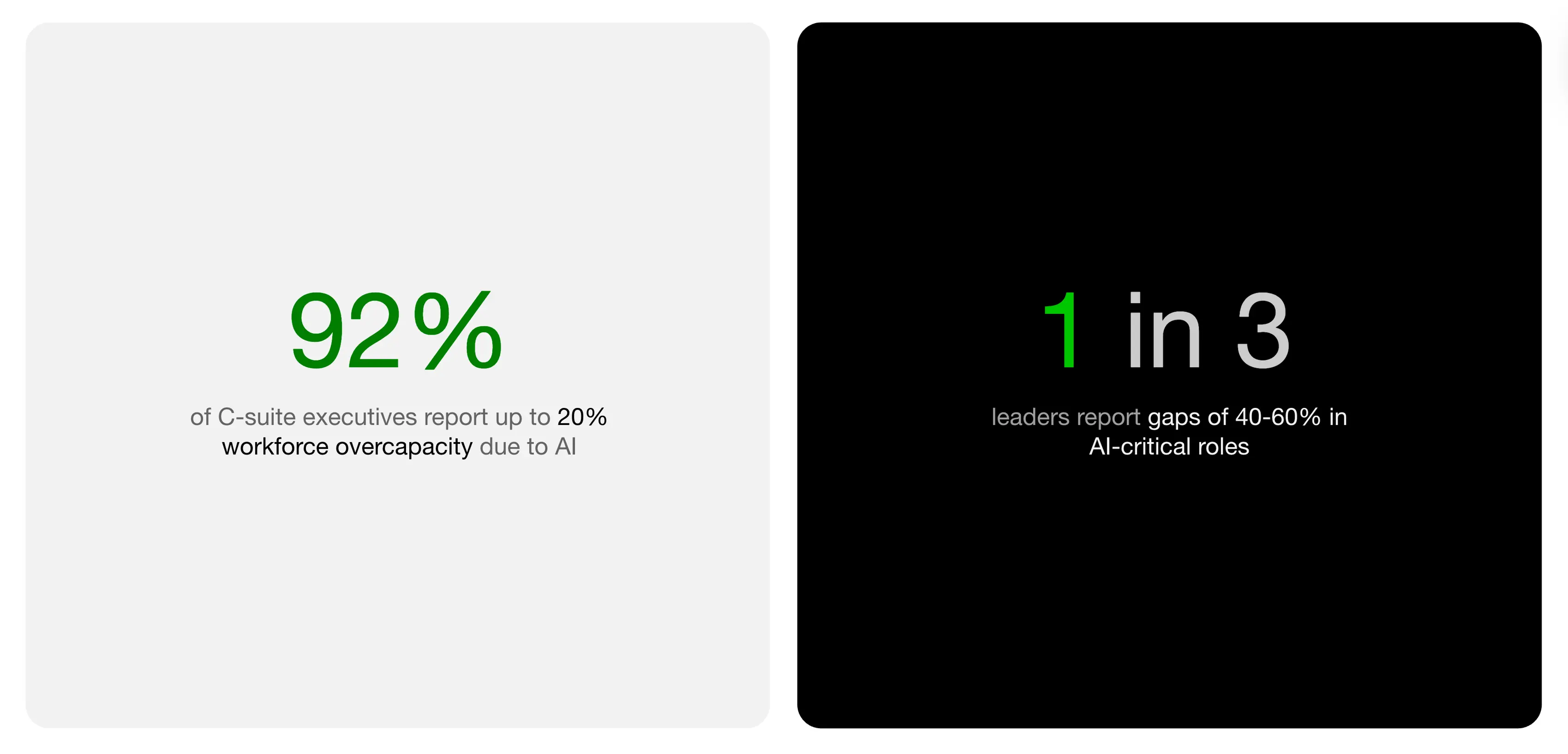
Overstaffed and under-skilled simultaneously. AI is making a longstanding problem extreme, and traditional hiring cannot resolve it quickly enough.
"AI moves faster than FTEs can support.”

Ernesto Lamaina
GM, Lifted
Every month, AI models make meaningful leaps. New implementation projects emerge; priorities shift; the specific skills needed change with them. Staffing those projects through traditional recruitment, approvals, job descriptions, notice periods, onboarding, ramp time often means you've already missed the window.
The contingent model collapses that timeline. Here are the three strategic advantages it delivers in the AI era:
Immediate velocity
Time to ROI is dramatically shorter. In AI implementations, that difference translates directly into competitive advantage. Every week of delay has a measurable cost.
Strategic agility
Scale up fast when something works. Scale back without penalty when it doesn't. AI projects require the ability to act on what you learn quickly.
Diverse exposure
Many contingent workers have already self-trained on the exact AI tools enterprises need. They're ready to deploy from day one, no months of internal upskilling required.
The high cost of fragmentation
Even companies that understand the opportunity, even those actively investing in contingent-led AI strategies are running into the same core obstacle: fragmentation.
Contingent labour is one of the most fragmented industries in existence. Different vendors. Different contract types. Different countries, systems, and engagement models. Most VMS tools handle part of the picture. And when you can't see the full picture, you can't manage it. Costs and compliance risks accumulate silently.
"Fragmentation between vendors, systems, contract types, countries, and engagement models leads to the impossibility of managing all different worker types in a single fashion."
Ernesto Lamaina
GM, Lifted
Every structural constraint you put on contract type or geography is a self-imposed restriction on your talent pool. A constrained talent pool cannot deliver the flexibility that AI demands. It's that direct.
The companies succeeding right now have confronted their fragmentation head-on, and built infrastructure that lets them operate across all worker types and geographies without artificial limits.
Comparison: legacy vs. AI-era models
Fragmented (Legacy) | Unified (Lifted) | |
|---|---|---|
Hiring Speed | 30–60 Days | < 3 Days |
Visibility | Siloed / Delayed | Real-Time / Global |
Compliance | High Risk | 100% Indemnified |
Unit Cost | Fixed / High | Optimized / Variable |
Take action: the 3-step playbook for contingent workforce leaders
To unlock the full value of contingent talent in the AI era, organizations need a structured approach. Lifted’s proven framework focuses on three steps:
1. Analyze: Build Your AI Workforce Map
This goes beyond traditional workforce analysis.
It’s not just about:
Spend
Regions
Worker types
It’s about understanding how AI will reshape demand.
Key questions include:
Where will AI increase or decrease workforce needs?
Which roles require human-in-the-loop support?
Where are the emerging skill gaps?
How will FTE, AI, and contingent talent interact?
This step lays the foundation for strategic workforce planning.
2. Unlock: Enable Flexible, Global Talent Access
AI requires extreme flexibility—not incremental improvements.
Organizations must be able to:
Engage talent in any geography
Use multiple contract types
Scale up or down rapidly
This means removing structural barriers such as:
Rigid hiring policies
Limited vendor networks
Country-specific restrictions
The goal is simple: maximize access to talent, wherever it exists.
3. Optimize: Continuously Improve Cost, Speed, and Quality
Optimization cannot wait until AI is fully implemented. By then, it’s too late.
Instead, organizations must:
Continuously refine contract models
Leverage global talent arbitrage
Align workforce structure to AI-driven workflows
The outcome:
Lower costs
Faster delivery
Higher-quality outputs
Case Study: Deploying 3,000 AI Workers in Days
A leading technology company needed 3,000 skilled workers deployed across 60 countries within days — not weeks — to complete 2.7 million human-in-the-loop tasks requiring specific language capabilities. It was only possible because the analysis work had been done in advance.
What this means for the future of contingent workforce
Contingent workforce programs have often been positioned as procurement functions, important, but not strategic. The AI era changes that positioning permanently.
The new enterprise workforce model is a deliberate blend of permanent employees, AI agents, and contingent talent. The contingent layer is what enables companies to execute on their AI roadmaps at the speed AI demands. That makes CWP leaders not managers of a cost line, but orchestrators of competitive advantage.
"Contingent becomes the fuel for AI. It's how you make your company AI-ready."
Ernesto Lamaina
GM, Lifted
AI is creating an entirely new category of contingent work, requiring speed, specialization, and flexibility that didn't exist at this scale before. Many legacy contingent roles will disappear. But the companies that move now — that analyse, unlock, and optimize before the window closes will be the ones whose AI investments actually deliver.
The question isn't whether your program needs to evolve. It's whether you'll lead that evolution or follow it.
Frequently asked questions
Is AI adoption going to eliminate the need for contingent workers?
Not in the way most headlines suggest. AI is eliminating certain legacy contingent roles but it's simultaneously creating an entirely new category of human-in-the-loop, implementation, and oversight roles that require skills that didn't exist two years ago.
Should we stop hiring FTE’s and move everything to contingent?
No, and this is an important distinction. Permanent employees remain essential for core, strategic, and long-term functions. The AI-era model is a deliberate blend: FTEs for strategic continuity, AI agents for scalable execution, and contingent talent for variable, specialist, and fast-moving projects. The question isn't "FTE or contingent?" — it's "where does each model create the most value, and is our program structured to deliver all three?
How long does it take to reach AI-readiness?
The analysis phase alone typically takes three to six months for a large enterprise, and that's before any operational changes are made. Unlocking flexibility and optimising across engagement models is an ongoing process, not a one-time project. The companies that are furthest ahead started this work before they thought they needed to. If you're waiting until there's an urgent AI talent request on your desk, you're already behind the curve.
What is the most important thing a contingent workforce leader should do right now?
Start the analysis. Not a spend review — a strategic assessment of how AI is going to shift your company's talent needs over the next 12–24 months, and where your programme currently sits in relation to that. The CWP leaders who are having the most impact right now are the ones who brought this analysis to the table before they were asked for it. That's what positions the program as a strategic function, and positions you as the leader who saw what was coming.
Author
Ernesto Lamaina is the General Manager of Lifted, an Upwork company dedicated to helping enterprises source, engage, and manage contingent talent across every contract type—independent contractors, staff augmentation, employer of record, and managed services.